TLS-RPT check (TLS Reporting)
TLS-RPT provides reports when inbound mail delivery fails TLS requirements. It is the visibility layer for transport hardening.
- TLS-RPT is mostly about visibility: seeing when secure transport fails instead of discovering it too late.
- The full audit makes more sense if you also care about MTA-STS and broader email hardening.
TLS-RPT is specialized enough that it works better as a guide here. The actual live scan remains grouped on the homepage.
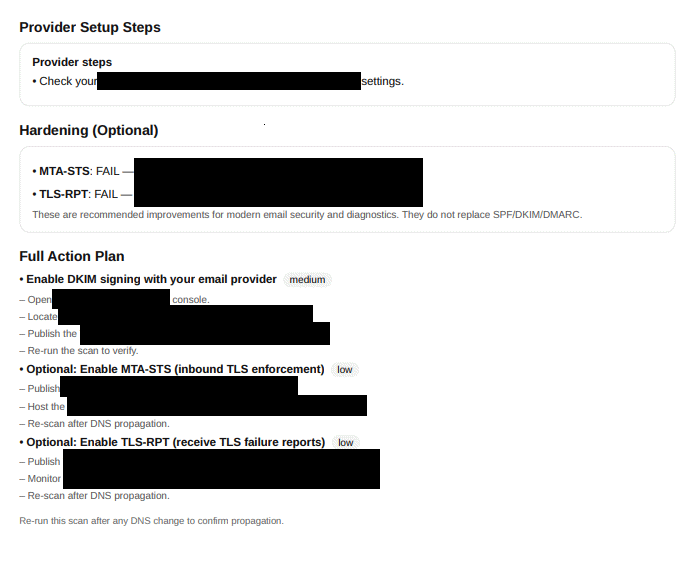
What the TLS-RPT report looks like
TLS-RPT is easy to describe in one sentence and still hard for buyers to prioritize. A sample report helps because it turns an obscure standard into a visible operational outcome.
- You see whether the record exists.
- You see whether
rua=is usable. - You see how TLS-RPT fits with MTA-STS and the rest of your mail posture.
What you need for TLS-RPT
TXT record
Publish _smtp._tls.yourdomain with v=TLSRPTv1; rua=mailto:....
Report endpoint
Use a mailbox or HTTPS endpoint to collect and analyze reports.
Pair with MTA-STS
Use both protocols together for stronger control and visibility.
Monitor regularly
Review reports to catch certificate and routing issues early.
What teams usually underestimate
Receiving reports is not the same as reading them
A mailbox can collect TLS-RPT data for months without anyone turning it into action.
Transport failures are often intermittent
That makes TLS-RPT valuable even when day-to-day mail flow looks normal on the surface.
It adds visibility, not enforcement
TLS-RPT tells you what is failing. MTA-STS is what adds the stronger transport policy stance.
It matters more at scale
The more systems and partners exchange mail with your domain, the more useful transport diagnostics become.
Why this still matters even if it is optional
TLS-RPT is rarely the first deliverability fix, but it is one of the clearest ways to make inbound transport failures observable. Optional does not mean useless; it means it belongs after your authentication basics.
Practical rule of thumb
If you are still trying to get SPF, DKIM and DMARC to a stable state, TLS-RPT can wait. If your authentication basics are already in good shape and you want earlier warning when secure transport breaks, TLS-RPT becomes a sensible next layer.