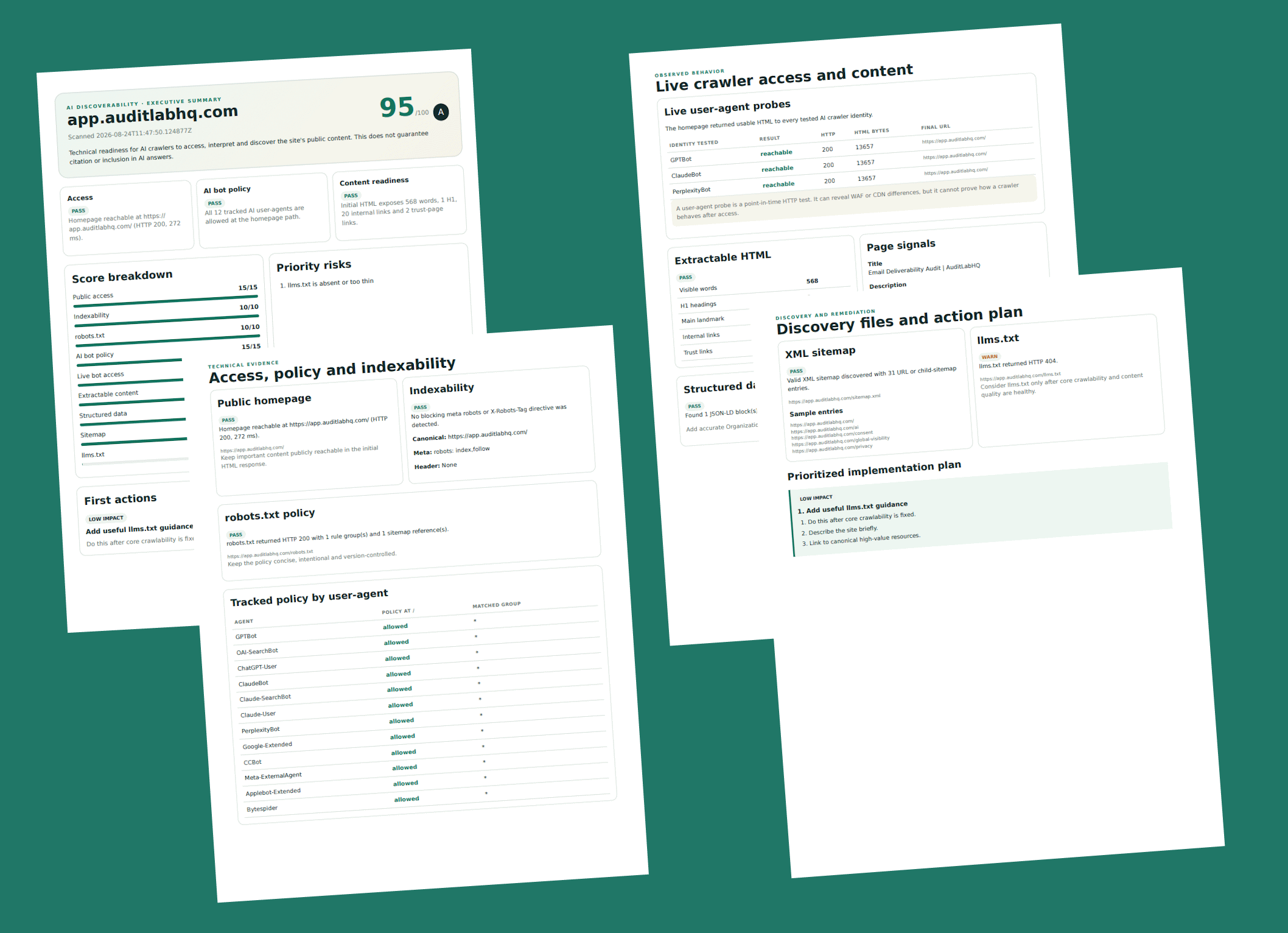
Public access
PASSHomepage responds publicly.
AI Audit
Measure whether AI systems can access, interpret and discover your public content, with evidence from live crawler probes, page structure, policy files and discovery signals.
GPTBot · ChatGPT-User · Google-Extended · ClaudeBot · PerplexityBot · CCBot
Free · No email required · Results in seconds
AuditLabHQ only reads public website signals. Nothing is modified.
Example audit
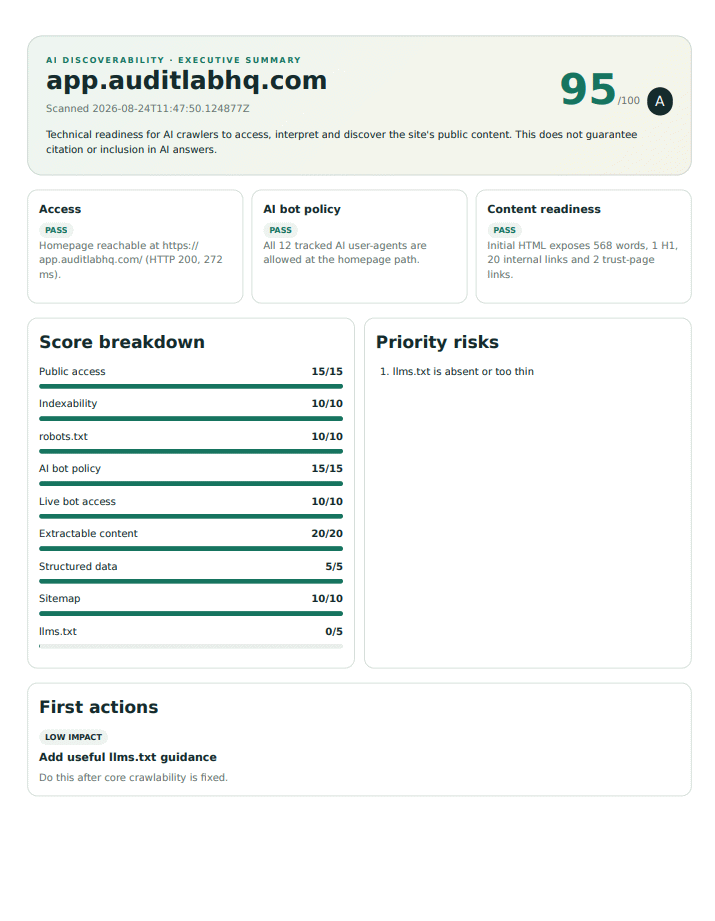
78/100 B
Example severity: medium
Homepage responds publicly.
Crawler policy is reachable.
Some crawler rules need review.
Useful HTML content is exposed.
Organization signals are incomplete.
No useful file was evidenced.
What makes the audit useful
We resolve wildcard and explicit rules for 12 search, training and user-triggered AI agents.
Live probes reveal when CDN, WAF or challenge behavior disagrees with the published policy.
We inspect initial HTML, headings, canonical/indexation, internal trust links, JSON-LD and discovery files.
What the audit checks
See how robots.txt shapes AI crawler access and where teams usually over-block themselves.
A practical guide to allowing public AI crawlers without turning the site into a free-for-all.
What llms.txt can and cannot do, and why it is not a replacement for robots.txt.
A short pre-launch checklist for teams that want discoverable public content.
A breakdown of the most common causes: homepage errors, bot blocking, missing files and ambiguity.
No. It checks crawlability signals, not ranking, retrieval quality, citation policy or model behavior.
No. robots.txt is the more established crawler control layer. llms.txt is best treated as supplementary guidance.
Not necessarily. The useful decision is intentional access, not blanket access or blanket blocking by default.
 Recommended